11 Apr 2026
The baby portfolio
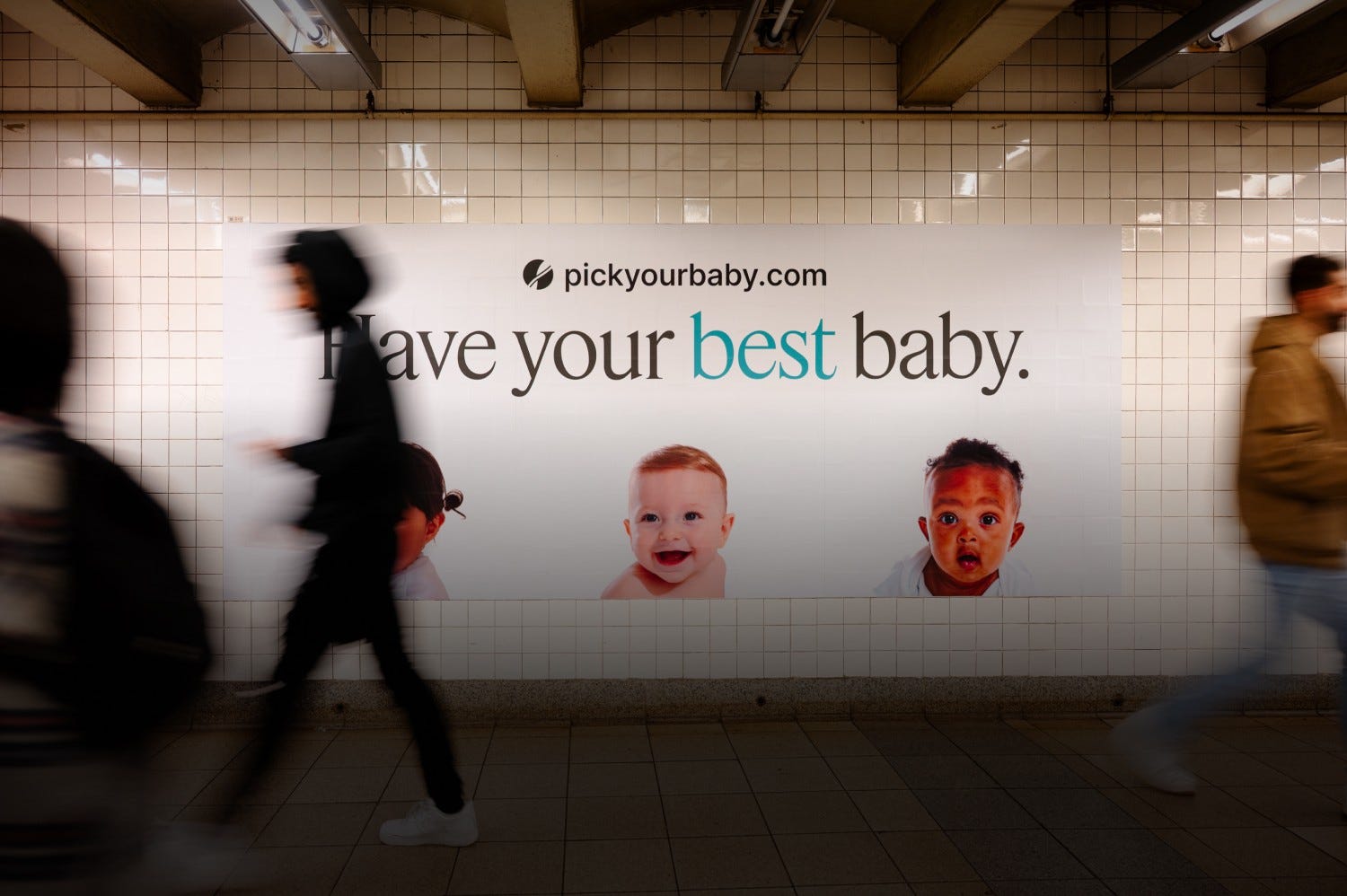
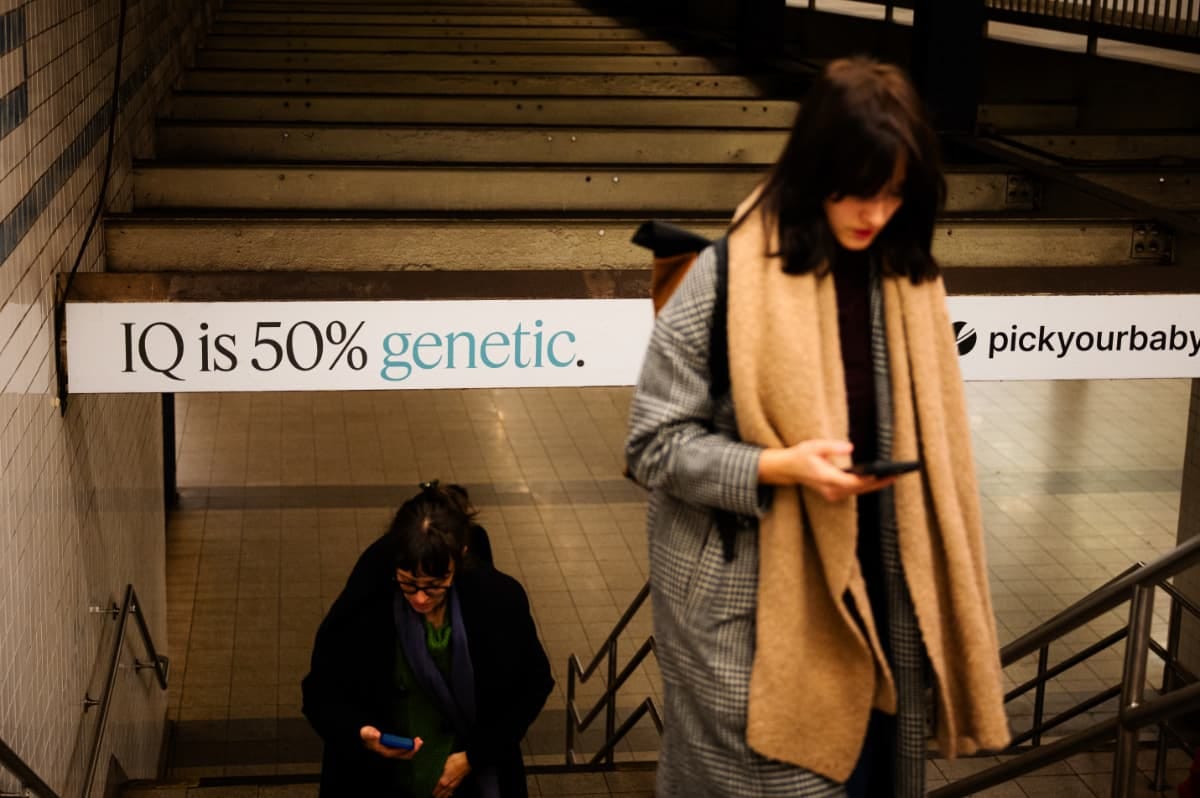
Somewhere in a New York subway station, November 2025, a startup called Nucleus decided the right place to advertise embryo screening was next to ads for therapy apps and oat milk delivery, clean design and optimistic copy in the visual language of rational consumer choice, the kind of poster you register for half a second before the train arrives and you forget about it entirely, unless you don’t.
That moment is worth sitting with, not because a subway ad is alarming in itself, but because of what it reveals about how a shift like this actually happens. Not through government programs or explicit ideology but through the slow accumulation of normal-looking decisions that each individually seem fine.
What these companies sell, concretely, is this : a couple does IVF (in vitro fertilisation), gets several embryos, sends cells from each one to be sequenced and receives scores back on disease risk, predicted height, and depending on which company, something called a cognitive potential score, which is where the science gets murky. Screening for single-gene disorders has existed for decades and nobody serious disputes its value. The new thing is extending the same dashboard logic to polygenic traits, the ones shaped by thousands of genetic variants interacting with each other and with everything that happens after birth, including nutrition, stress, education, and developmental randomness. The ASRM concluded in late 2025 that polygenic screening for intelligence is not ready for clinical use. But the companies selling it are not waiting.
The gap between what the science can do and what gets advertised is not incidental to this market but structurally necessary, because a company that accurately described its product as a modest probabilistic adjustment across a small pool of related genomes with high variance and no guaranteed outcome would have no customers. So instead you get “give your child every advantage,” a sentence engineered to make not using the product feel like a parenting failure. That mechanism is worth paying close attention to, because it will govern everything that comes next regardless of what the science actually delivers.
The trajectory doesn’t require a conspiracy to unfold. Medical prevention is the entry point because it’s genuinely defensible, the infrastructure gets built around that framing, couples get used to comparing embryos on a dashboard, and the categories on that dashboard expand because companies need to sell premium tiers and the data exists and nobody technically stops them. Longevity scores are already a selling point at some clinics, the Wall Street Journal covered this in 2024. Cognitive scores are already on offer even though the scientific establishment considers them premature. This isn’t a slippery slope argument so much as a description of a product roadmap that’s already underway.
There’s a philosophical shift underneath all of this that tends to get lost whenever the conversation turns to whether the science is good or bad. There is a real difference between an embryo implanted because it happened to be viable and one selected from a ranked list on the basis of predicted traits, because in the second case the child arrives already evaluated. You looked at the options and chose this one, and part of what you were doing while choosing was comparing projected futures across candidates who didn’t yet exist. Accept all of that as a neutral development and you still have to notice that it changes the structure of the relationship before the relationship begins, from something that resembles receiving a person toward something that resembles managing a portfolio.
The word eugenics makes people think of 20th century state programs, forced sterilizations, racial hygiene administered by ministries, and what’s developing here shares the underlying logic while looking nothing like any of that. No coercion, no state mandate, no explicit ideology stated anywhere. Instead there’s a market, private clinics, consumer apps, couples who consider themselves progressive and scientifically literate, and the gradual normalization that always follows the same pattern: make it available to the wealthy first, wait for it to become associated with responsible parenting, then let social pressure handle the rest. The Hastings Center calls this liberal eugenics, distributed across millions of private decisions rather than mandated from above. The mechanism is softer but the destination isn’t obviously different.
The expected gain from selecting among three or four IVF embryos is genuinely modest given that you’re working with a small pool of related candidates rather than engineering from scratch, and the variance is enormous relative to the effects being advertised, but that’s almost beside the point now. By the time the science either catches up with the marketing or definitively fails to, the cultural infrastructure will already exist, the clinics, the apps, the social expectation that serious parents optimize, the quiet judgment toward those who don’t, and that infrastructure is considerably harder to dismantle than a startup.
What also makes this harder to dismiss than previous waves of genetic optimism is that it's arriving at the same moment as systems that can actually model biological complexity at scale, and the honest answer is that nobody knows what polygenic prediction looks like when AI can process the full developmental picture rather than a handful of statistical proxies. The embryo scoring of 2026 may look as primitive relative to what comes next as a blood pressure cuff looks relative to an MRI, which means the cultural normalization happening right now is essentially laying the groundwork for a technology that doesn't exist yet. We're getting comfortable with the logic before we've seen what the logic can actually do.